rss

Friday, September 18, 2009

The Conception of Padmasana: Balinese holiest Building

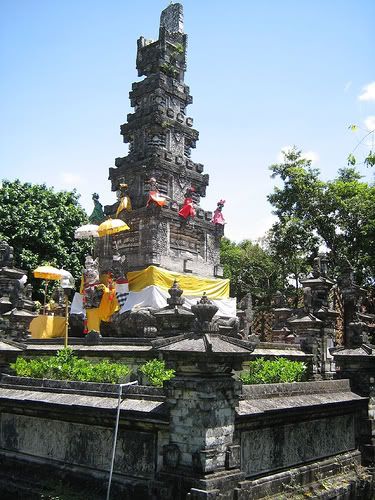
Padmasana is a shrine to the Hindu people of Bali to worship the Almighty God (Ida Sang Hyang Widhi Wasa). Although Hindu religion in Bali is from India, but the Balinese combined it with the breath of the original Balinese ancient believes. Padmasana is the symbol and image of the macrocosm or universe (Bhuana Agung). This shrine can be found in the Hindu holy building in Bali or outside Bali (Indonesia), even this sacred building is placed in the main shrine.

As with the global issue as local traditions that began to disappear in this digital era, where conditions have turned from sacred to profane. Bali community lives with the era of cultural transformation, from a religious philosophy to the business economy. Now many of the craftsmen who made Padmasana (instantly) that deviate from the basic rules and basic philosophy.

This should make our reflections to move forward. This paper is dedicated to the people who want to explore the basic conception of padmasana, so even if crushed by the modern era but the philosophy remains essentially stored in our memory as a preparation for religious life and the preservation of religion itself.

History of Padmasana

Padmasana as a picture of the universe, from the point of history can be seen in ancient palmleaf scipture Lontar Dwijendra Tattwa mentioning that Padmasana developed by Danghyang Dwijendra, he is also known as or Pedanda Sakti Wawu Rauh, Mpu Kuturan, Danghyang Nirartha.

He came to Bali in the year 1489 AD, during the period of royal administration of Dalem Waturenggong in Gelgel (1460-1550). He came with the aim to improve the religious life in Bali (Sugriwa, 1991). Where before his arrival, Hinduism in Bali has been well developed, because it has been accepted doctrine of the all-Rsi who come to Bali since the 8th century, such as Rsi Markandeya, Danghyang Siddimantra, Danghyang Manik Angkeran, Mpu Jiwaya, Mpu Gnijaya , Mpu Sumeru, Mpu Ghana and Mpu Bharadah.

The Maharsis brings religious sects that developed in Bali and mixed with local beliefs Bali as animism, dynamism, etc. Dwijendra Tattwa further told that when he entered the island of Bali, he is dreaming suck in into a large dragon's mouth and inside the dragon's stomach, he saw a lotus flower growing. Unfortunately there is no pollen (sari bunga) inside.

This illustrates that the dragon is a Anantabhoga Dragon is a symbol of the island of Bali. Where Hinduism is well developed, but only to worship deities as a manifestation of Ida Sang Hyang Widhi Wasa, not directly to God. This situation is symbolized as a lotus flower that blooms without a pollen (sari bunga).

Because of Danghyang Dwijendra the Balinese people adding pelinggih form (place of worship) into the form of a Padmasana, a perfect symbol to worship God Almighty (Ida Sang Hyang Widhi Wasa) in full conception. Both in terms of the concept of horizontal or vertical.

The development of Padmasana can clarify the physically ambiguities of pelinggih. All in other word can defined as turned from the building to worship many gods become a place to worship one God (Ida Sang Hyang Widhi Wasa). Until now, Padmasana shrine can be found in all temples in Bali as a main building.

Symbols and Meaning

Padmasana comes from the Kawi language (old Javanese languages) of two words namely, Padma means ‘lotus flower’ or ‘center’. Asana means being seated or guidance or advice or orders (Wojowasito, 1977). Padmasana means the place of the red lotus as sthana (place to stay) the holy God Almighty (Titib, 2001; 106).

Based on these two opinions is clear that the lotus flower is a symbol of the seat of God Almighty. Thus analogous to that Padmasana agreed with the meaning of Padmasana is the image of the universe (Macrocosm) which is sthana (a place to stay) of Ida Sang Hyang Widhi Wasa (God Almighty).

In Lontar Padma Bhuana, Danghyang Dwijendra stated that Bali as Padma Bhuwana ( "lotus flower" of this planet). Lotus Flower (Padma) used as a symbol of the universe ,sthana (place to stay) of the Almighty God.

Furthermore, in the Lontar Dasa Nama Bunga (palmleaf scipture) write that the lotus flower is the king of all flower (Raja Kesuma) because it is the lotus flower in three natural life, which is roots stuck in the mud, leaves in water, and flowers above the water (air).

Because of his life in this three natural , padma flower is a symbol of Tri Loka-Tri Bhuwana (three dimension of world), sthana (place) God Almighty (Ida Sang Hyang Widhi Wasa). The leaves and flowers of many layers as the symbol of the nine cardinal directions of the universe (Sanga Mandala) (Wiana, 2004:69).

If associated with the position in meditation or yoga, Padmasana position is sitting cross-legged position with both feet folded up, so that looks like a circular position. This may not fit with what we see in general, even at the top padmasana throne was shaped like a rectangular king's square-shaped seats (singhasana).

This will be answered if we consider of pesimpen or mendem pedagingan ritual. This ritual implanted pancadatu (5 kind of metal) at the base, in the middle or at the top of the Padmasana when the validation of a ritual process turning ordinary building into sacred building in Balinese Hinduism.

It would appear that the contents of pesimpen pedagingan, especially pedagingan on padma-shaped which is made of gold placed on top, on this the throne-shaped chair square. Because of the golden-Padma which is planted, even though located on the top, it was not visible from the outside. By this golden Padma which implanted on the top on the building so called Padmasana.

Padmasana symbols represent the natural levels Tri Loka (Bhur Loka, Bwah Loka, Swah Loka). This can be seen from Bedawang Nala (big turtle in Hindu mythology) with two dragons (Anantaboga and Basuki). This represents the lower nature or Bhur Loka, Padma bodies including the throne-shaped chair that symbolizes the earth's atmosphere or Bwah Loka, While not described Swah Loka in the form of buildings, but in a tangible Padma shaped pesimpen pedagingan ritual and in worship that are described with "Om Padmasana Ya Namah" and " Om Dewa Pratistha Ya Namah".

In the philosophy of Hinduism, the universe is like unto a "body" of the Ida Hyang Widhi Wasa and known as the great universe (Bhuana Agung). As for the little universe (Bhuana Alit) is the human body with the Atma (human soul) as sovereign. If Sang Hyang Parama Siwa (another name of Ida Sang Hyang Widhi) as the soul of the Bhuana Agung (great universe), then the Sang Hyang Atma Siwa is the soul of Bhuana Alit (little universe). Bhuana alit is a mini form of Bhuana Agung, in the sense Bhuana Agung is similar with Bhuana Alit.

The Padmasana Form

Padmasana building forms similar to the temple which was developed with pepalihan (ornaments with highlights of the building elevation). Padmasana not use the roof on this top symbolizes the unity between the Bhuana Agung with Bhuana Alit. The building consists of parts of the foot called Tepas, the body called Batur and the head called Saris.

1. At the foot (base)
there are tangible carving Bedawang Nala (big turtle in Hindu mythology) are wrapped by the Anantaboga Dragon and the Basuki dragon binding between Bedawang Nala and the foundation of the building Padmasana. Then there are also carvings of lotus flowers and karang asti (elephant ornament symbolized power).

2. In The Body (center)
There pepalihan form of decoration, karang goak (crow ornament), karang simbar (leafs ornament), karang asti (elephant ornaments), Garuda (Lord Vishnu ride), a geese and statues of the Astadikapala Gods (guardian 8 cardinal directions) as: Lord Iswara (east), Lord Brahma (South), Lord Mahadewa (west), Lord Vishnu (North), Lord Maheswara (southeast), Lord Rudra (South-West), Lord Sankara (Northwest) and Lord Sambhu (northeast) . These gods carry weapons and with his complete attributes. There is also Padmasana with Lord Vishnu rides Garuda bird carrying Tirta Amrita (the water of life) like Padmasana at Pura Taman Ayun-Mengwi.

3. At the head / sari
Is a throne flanked by Taksaka dragons made of carved sandstone. On the back there in the middle ulon are engraved portrait or Sang Hyang Acintya or Sang Hyang Taya as a symbol of the realization of Ida Sang Hyang Widhi Wasa. This painting illustrates the attitude of the dance of Siva called Shiva Nataraja in creating the universe.

The Function of Padmasana

Padmasana main function is as a place of worship of Almighty God. Holy building to worship God in his function as the soul of the universe (the macrocosm) with all almighty aspects (Dewa Pratistha). So no Padmasana as the worship of ancestral holy spirit (Atman Pratistha). As in Besakih temple (the mother temple of Bali), Padmasana we can see that in lined three-sthana (place) it is Parama Siwa (middle), Sadasiwa (Right) and Sang Hyang Siwa (Left).

Pelinggih Padmasana is sthana (place) symbol niyasa or Ida Sang Hyang Widhi Wasa, with various titles, That Sang Hyang Siwa Raditya the manifestations of God as the sun (solar) and Sang Hyang Tri Purusa, the trinity of Siwa, Sada Siwa and Parama Siwa.

Typology

According Lontar Wariga Chatur Wisana Sari, Padmasana layout (Pengider Bhuwana) distinguished by typology and based on the form rong (space) and pepalihan (level or undag)

Based on the Layout

Based on the location of Padmasana distinguished by the direction of the wind (Pengider Bhuana) into 9 types, namely:

1. Padma Kencana, in the east (purwa) facing west (pascima).
2. Padmasana, in the south (daksina) facing north (uttara)
3. Padmasari, in the west (pascima) facing east (purwa)
4. Padma Linga, in the North (uttara) facing south (daksina)
5. Padma Sedhana Asta, in the southeast (agneya) facing to the northwest (wayabhya)
6. Padma Noja, in the southwest (nairity) facing northeast (airsaniya)
7. Padma Karo, in the northwest (wayabaya) facing the southeast (agneya)
8. Padma Saji, in the northeast (airsanya) facing to the southwest (nairity).
9. Padma Kurung, in the midst of the temple (middle) facing toward the exit / entry gates (pemedal).

The selection was also based on the location of Padmasana considerations of the temple lay out where the hulu-teben conception. Hulu-teben philosophy arises because human beings is difficult to imagine God, then people think God is like the man himself has a head, body and legs.

Hulu said to be head , as an intermediate body and legs as teben. This concept brings the life skala (real) and niskala (unreal). for example, in order to build temple. The existence of a very sacred part of the so-called Utama Mandala (private space), the less sacred called Madya Mandala (semi-private space) and the part is not sacred called Nista Mandala(public space).

Hulu-teben uses two references which are:
1.East as hulu, as the sun rises (the sun here is defined as a source of life energy /good connotation) and the west as teben (mean connotation of death).
2. Mount as hulu because of the Balinese considered mountains is a sacred place where the gods lives and the sea as teben (exile), like the water cycle in nature. Because according to the Balinese life would not exist if there is no water

Source:
Acwin Dwijendra, Ngakan Ketut,2008, Arsitektur Bangunan Suci Hindu Berdasarkan Asta Kosala-Kosali, Denpasar, Udayana University Press

Acknowledgement
Sugriwa, IGB. 1991. Dwijendra Tatwa. Denpasar. Upada Sastra
Titib, I Made. 2001. Teologi dan Simbolis Dalam Agama Hindu. Surabaya; Penerbit Paramita.
Wiana, I Ketut. 1992. Palinggih di Pamerajan, Denpasar: Upada Sastra

Read more...

Saturday, September 12, 2009

The Function Of Water (Tirtha) In Balinese Hindu Rituals


I. INTRODUCTION

The Balinese belief and worship of Hindu Dharma in Bali governs all the activities of the daily life of the Balinese. The three basic fundamentals of Hindu Dharma are Yadnya (rituals), Tattwa (philosophy) and Susila (moral behaviour), which are interacted to form Balinese culture. Hindu religion is originated from India. The practice of the Philosophy in the Balinese Hindu in Bali is almost similar to the practice of Hindu in India whereas in Balinese Hindu is moreattached to the local culture. Basic practice of rituals are based on the Vedas (Holy Manuscript) and the philosophy of Yadnya (rituals ) are also referring to it.

There are five types of Yadnya
( means holy sacrifice with a pure heart) in Balinese Hindu:

1)Dewa Yadnya: to the Gods and Goddesses as manifestations of the Supreme Being.
2)Pitra Yadnya: to the ancestors who give the people guidance in life and gave them the opportunity to be born.
3) Manusa Yadnya: to protect our lives and those of future generations
4)Rsi Yadnya: to the priests who guide us all on our spiritual journey.
5) Bhuta Yadnya: to any other beings (visible and invisible) to ensure that there will be harmony and unity in nature.

In Hindu believers there are important elements of nature to be considered as the guideline of rituals in retaining the harmonious living of the human being (Nair,2009). Those elements comprise of: earth, water, fire, air, and akasa/ether or sky ( which are called as panchamahabhuta). Among the five elements water is represented by a circle symbolises fullness based on the graphical depiction of panchamahabhuta. Primarily water is the building block of life and all the living beings are at the mercy of God, for the water.In India as well as in Bali water has been an object of worship from time immemorial, which signifies the non-manifested substratum from which all manifestation arise. This leads the
practice of utilizing water as the purification of all rituals. In conducting every religious rite, the presence of holy water is the most important part of all Balinese ceremonies (Agastia, 2007).
Holy water accompanies every act of Balinese-Hindu worship from individual devotion at household shrine to island-wide ceremonies.


II. DESCRIPTION

In Bali, there is no single day without a ceremony. It is an obligation for the people to promote balance relations among human, Divine, and nature. As has it was mentioned previously among the five elements water is represented by a circle symbolises fullness based on the graphical depiction of panchamahabhuta. Primarily, water is the building block of life
and all the living beings which are at the mercy of God. Balinese Hindu appreciate water is not only needed in their daily life but also has a very important function in religious ceremonies. Water, in Balinese Hindu has various terms as follows:

2.1 TERMS OF WATER

1. Odaka (Odakem), water in common meaning which has the function for hands and mouth cleanliness, for drinking, etc.
2. Toya (Toyem), water which has the function in religious ceremonies. Toya means water and in common sense for washing hands or ceremonies completeness, and it can also means the water which has been purified. In Bali, the term toya is often used for mentioning the water in discussing about people who are appreciated more.
3. Tirtha, is the purified water. The purification is done through the specific mantram chanting by authorized person a priest Pedanda or pemangku or even obtain from a certain place with special ceremonies.
4. Wangsuh-pada, tirtha which is taken or beseeched at a shrine ‘pelinggih’ or aplace supposed to be sacred.

2.2 TYPES OF WATER ACCORDING TO BALINESE HINDU (Swastika, 2008)
In Balinese rituals there are two types of water utilised as worship medium, i.e:
1. Water which as the function to clean hands and mouth, in practice this type of water is utilized to clean oneself before conducting prayer in the temple or attending ceremony.
2. Water as tirtha comprises of holy water (tirtha) obtained from certain sources from sacred place or beseech from the shrine or the temple in which certain manifestation of Goddess being adored/worship and tirtha performed by priest through certain mantras.

2.3. TYPES OF TIRTHA ACCORDING TO HOW IT IS OBTAINED
1. Tirtha Wangsuhpada
2. Tirtha Sulinggih

1. Tirtha Wangsupada
The tirtha obtained from certain sources is usually through beseech to the Devine or Goddess. These may be performed by placing water in the temple or shrine and in that manner the worshipper hope the blessing from the Devine. This type of tirtha is usually beseeched by the pemangku or dasaran of the temple or shrine in the companion of certain type of offering named canangsari.
Certain places can be regarded as the source of tirta such as Tirtha Empul. The worshipper can obtain tirtha with particular type of offering for certain purposes as in Tirtha Empul is regarded as the holy place to abtain tirta from the source.
Here are the types of tirtha obtained from Tirtha Empul (Tampak Siring Gianyar):
· Tirtha Pemarisuda
· Tegteg
· Suddhamala
· Bayun Cokor
· Pemelaspas
· Empul
· Pengentas

2. Tirtha Performed by Pemangku and Priest
Priest in performing types of tirtha according to the purpose and function of the rituals. The tirtha performed by priest through Ngarga Tirtha in Panca Yadnya (five types of rituals):
tirtha pengelukatan, pebersihan, ,prayascita and byokaon,pemelaspas, penembak, pengentas and pecaruan.

Tirtha performed by pemangku and preist is depending on the purpose of the rituals or ceremony that are several tirtha performed by them such:
1. Tirtha pengelukan and pembersihan, this is type of tirtha is used in every ritual, it is sprinkled three times over the offering before it is offered to the God. In every house
the Balinese Hindu always store tirtha in jar or container for the daily offering either mesaiban or ngaturang canang (small ornament of offering)
2. Tirta prayascita and byokaoan, this type of tirta performed by the priest in which it is used as puroifiaction of a place, or to sprinkles toward the warshippers before prayer when there a large ceremony happened in the temple or after attending a funeral/cremation those who were just arrived from such visit thay had to be given prayascita and byokaon to clean them themselves from the dirt or the uneasy of mourning feeling and back to normal activities.
3. Tirtha Pemelaspas, this type of tirtha is performed by priest whenever the worshipper has a new premises, or new business this is aims at beseeching for the blessing from the God that in the hope everything related to the new premises and business will run smoothly.
4. Tirta pengentas this type of tirta is performed by the priest to accompany a cremation in the hope that the death will be lead to the right track in his/her appearance before the divine.
5. Tirta pemanah this type of tirta is performed by priest which also to accompany in the cremation in order that the death will find smooth path in journey to Heaven
6. Tirta pecaruan comprises from small to higher purification ceremony according to the type will be performed this type of tirtha only performed by preist ( mecaru siap besik,mecaru ayam lima, mecaru panca kelud, up to melabuh gentuh).
.Apart from the water mentioned above the Balinese Hindu also use the coconut water,whether the one which is already mature or even still young without any flash in it, named ‘kelungah’. There are three kinds of water utilized in religious ceremonies, namely: water incommon sense, the purified water (Tirtha), and coconut water. Among those three waters Tirtha has the most important role. It is the reason that the upakara and the offering being utilized in the ceremony have not yet been considered clean so the Tirtha is supposed to be able to purify those all then it is ready to be adored or worshipped to the Almighty God. On the contrary, although the upakara completeness and offering have been cleaned since those have not yet been purified with Tirtha, it is not proper to be adored to the Almighty God.

2.4 FUNCTION OF TIRTA

1. Tirtha which has the function to purify places, buildings, upakara completeness or even an individual. This kind of tirtha can be requested through mantram chanting by authorized person, in this case a priest or a pemangku. The ones which belong to this kind of Tirtha are tirtha penglukatan, tirtha pebersihan, and the kinds. There are also
tirtha which can be beseeched from certain places which have religious history or mythology like Tirtha Empul, Tirtha Tunggang, and the kinds. The young coconut water or air kelungah belongs to this kind of tirtha.

2. Tirtha which is utilized at the end or the last step of praying ceremony whether it is held at a certain place or temple. This kind of tirtha is commonly beseeched at a shrine ‘pelinggih’ which is supposed to be the main ‘pelinggih’ in a temple or sacred place and has close relationship with that temple. The term for this kind of tirtha is wangsuhpada.

3. Tirtha which is utilized in the rituals of the death as in cremation ceremony (ngaben) such as Tirtha Penembak, Tirtha Pemanah, and Tirtha Pengentas. The tirtha has to be sprinkled three times over the corpse before the corpse is going to be burnt.

Three times sprinkles commonly as the symbol of purification which include: initial, middle, and end. But if it is given to somebody, besides it is sprinkled three times on their head it also has to be consumed three times as the symbol of spiritual purification, and wash the face three times with the tirtha as the symbol of physic purification, and the sprinkle three times over the fontanel as the respectful of the power and purification of the tirtha. In the Weda Parikrama and Surya-Sevana, it is described that the purpose of utilizing the tirtha which is limited on an individual. It can be concluded that the function of tirtha in the ceremonies is to purify spiritually and physically (physic is cleaned with water, mental is cleaned with tirtha).

2.5 FUNCTION OF TIRTHA BASED ON ITS MEANING AND UTILIZATION

Based on the meaning and function tirtha can be formulated as the following:
1) as purification
2) as purgatorial medium
3) as source of life

1) Tirtha as purification
In conducting rituals all the medium of offerings such as rituals ornaments and offerings should be purified before they were offered as rituals to the Devine or Goddess. This means to purify and clean in spiritual world/niskala and further purified. As it was stated in the manuscript Lontar Kusuma Dewa and Gong Wesi: Salwiring bebanten yadnya matirta karya Pandita Putus tan ketampi aturannya (Swastika, 2008:85). This statement means that all mediums (bebantenan or offerings) if it is not purified previously with the tirtha performed by the Exalted Priest otherwise it will not be accepted. Based on this statement all mediums of offerings and forms of offerings previously should be purified before it is used as offerings.

2. Tirtha as Purgatorial Medium
The function of tirtha, besides as penglukatan, pebersihan, and penyucian all types of mediums and forms of offerings also has the function of purgatorial from all of the offerings in every rituals (yadnya). It is emphasized that banten not only comprises of various arrangements of leaves, fruits, seeds, cakes (jajan), and others but also as a unity of a ritual (upakara
persembahan) in the form of banten officially which become a religious medium with sacred value and spiritually enliven. All those ingredients of offerings are picked from the trees and it
will become mortal being. Furthermore they were arranged in such a way to become valuable and has spiritual meaning in the form of banten. A banten is considered proper according to religious conduct whenever it has been given the sprinkle of tirtha (penglukatan and pebersihan) on it. This is to purify all the dirt, physically and spiritually and the last to enliven it as banten or upakara as an offering or expression of bhakti of the Hindu worshippers before the Almighty God (Ida Sang Hyang Widhi as the Creator). The splash of tirtha as a means of pengurip or to enliven gives the spiritual strength of the banten. This can be further used as a medium to unite the worshippers and the Creator.

3. Tirtha as Source of Life
Tirtha functions as the source of life. Whenever there is no existence of water the possibility of the nature with its content will be extinct. This also happens in the process of ritual tirtha which has the function as a blessing from God to the worshippers who worship Him. In daily practise, every time after the prayer the worshippers will be purified with tirtha (delivery of holy water). Tirtha as a symbol of life and by delivering to the worshippers who pray before Him will receive Amerta (Immortality).

2.5 THE USE OF TIRTHA IN PRACTICE

Tirtha is holy water which is sprinkled before and after ceremony. The name and function of this holy water is depending on the ceremony itself, so that is why there are many names and functions of Tirtha. There are two types of Tirtha which is always found in a ceremony. The first one is Tirtha Pelukatan. This holy water is applied as soul cleanser before one enter a temple or start ceremony. Tirtha Pelukatan is sprinkled by the temple priest to all people before starting a ceremony. In some places in Bali when the temple ceremony was held Tirtha Pelukatan is put inside a big earthenware in front of entrance door and stained by the people themselves. The second Tirtha is called Tirtha Wangsuh Pada. This holy water is sprinkled after a ceremony is over as a symbol of God blessing to human.

III.CONCLUSION

In Balinese Hindu, Tirtha is the prominent medium in conducting all types of rituals from a small daily offering to the entire large and extraordinary types of ceremonies. Tirtha, the
existence as the basic purification in every ritual either the one obtain from a certain sources (Tirtha Wangsupada ) or the one performed by the Holy Priest (Pedanda) is very important. The Balinese Hindu always store tirta panglukan and pabersihan ( from the priest ) in container either made of earthen ware or jar (glass) in their home, which is utilized in conducting everyday rituals meassaiban or conducting every five days (kliwon) sacrifice as mesegeh.The origin of holy water reflects spiritual. Although the types and origin of holy water is varied, their functions both spiritually and philosophically remain the same which are remove impurity to performed purification and to receive God`s Blessing.

Author:
Ida Ayu Made Puspani and Ni Wayan Sukarini

References:
Ratnadi, Putu Ayu dan I Putu Patra. 2008. Tuntunan Malukat. Penerbit: Paiketan Pemangku
Werdi Dharma Prawerdhi Kecamatan Baturiti Tabanan.
Swastika, Drs. I Ketut Pasek. 2008. Puja Tri Sandya-Panca Sembah Arti dan Makna. Penerbit:CV. Kayumas Agung.
Wikarman, Drs. I Nyoman Singgih. 1998. Bayuh Oton: Ruwatan Menurut Kelahiran. Penerbit:Paramita Surabaya.
Doa Upacara Manusa Yadnya. Edisi Cetak: Maret 2007. Penerbit: Pustaka Manikgeni.
Sutareka, Mpu Jaya Danka. 2006. Argha Patra Pinandita/Pemangku Dalam Menyiapkan Tirtha Pebersihan. Penerbit: Paramita Surabaya.
Agama Hindu dan Air: Mengantisipasi Masalah Air di Bali. Dharma Prawerti Sabha
Dharmopadesa Pusat 10 Maret 2007.


Read more...

"Balian" Balinese Traditional Healer


Just about everywhere in Indonesia you will find that Balians, or Dukuns, are sought out to heal illnesses or dispel evil spirits. Even in a society where modern medical facilities are available, it is to the mystic person they go. There was an interesting article in the Bali Discovery regarding these most sought after members of Balinese society. Over on the neighbouring island of Java, the Javanese firmly believe that that the spiritual world is richly populated with deities who inhabit people, things, and places, and who are ever ready to cause misfortune. With the aid of a dukun, or through spiritual acts of self-control and right thinking, Javanese believe they can protect themselves against these harmful spirits by making offerings.

In the daily life of the Balinese the balians, or mystic mediums, play a central role. In fact, the name balian is loosely applied to a wide range of men and women who possess sacred skills or specialized knowledge in the performance of rituals of passage.
Members of the elite circle of balians may be called upon to interpret ancient lontar palm manuscripts, divine messages from the gods or ancestors, decipher “signs” of spiritual import hidden in the natural world, perform midwifery duties, prepare the dead for cremation, massage the sick, set broken bones or determine which family ancestor now inhabits the soul of a newborn child. The natural inclination to humility causes many Balinese who perform balian roles in their community to deny they fill a mystical or sacred function implied by that title; much as many gifted artisans in Bali do not view themselves as artists.
In an effort to understand exactly how widespread the role of the balian is in Balinese society, the Suryani Institute Bali is undertaking pioneering research to catalog the number and variety of balians operating in 20 remote villages in eastern Bali. Preliminary results from Karangasem reveal that at least 152 balians or paranormal practitioners are operating in that region, according to Dr. Cokorda Bagus Jaya Lesmana, the Secretary of the Institute quoted in NusaBali.
Dr. Lesmana, a young Balinese psychiatrist who is also the Son of Indonesia’s world-renowned psychiatrist and author Professor Dr. Luh K. Suryani, claims the balian plays a central and very beneficial role in local communities ranging from alternative medical practice to performing rain stopper services.
In surveying balians, the Institute intends to eventually improve cooperation and knowledge-sharing between traditional healers and modern medical practitioners with a particular emphasis on the treatment of mental illness and emotional disorders. In December 2007, the Suryani Institute Bali plans to hold a seminar involving medical and psychiatric experts and balians to discuss means of improving the mental health of local communities and curbing the rising suicide rates in Bali.
Actually, one of my rellies in Java is a Dukun (through marriage) and is a really nice guy and a good one. However, several years ago I tried to seek knowledge of his good practices but was soon scorned upon.

source:www.indonesialogue.com; image "cakra mangku" by saylow

Read more...

Bali Traditional Calendar

Guest Book

Name :
Web URL :
Message :
:) :( :D :p :(( :)) :x
 

Followers